Banks Have Won the Race for Kazakhstan’s Fintech Consumers. Startups Are Shifting Their Growth Models.
The “Fintech in Kazakhstan 2026” study shows that Kazakhstan’s fintech market has formed around large banking ecosystems. Banks have captured a significant share of the mass consumer market, making it increasingly difficult for independent technology companies to compete for end customers. At the same time, the development of Open Banking, Banking-as-a-Service (BaaS), shared payment infrastructure, and an evolving regulatory framework is creating new opportunities for small technology businesses.
Banks Have Captured the Core of Kazakhstan’s Mass-Market Fintech Sector
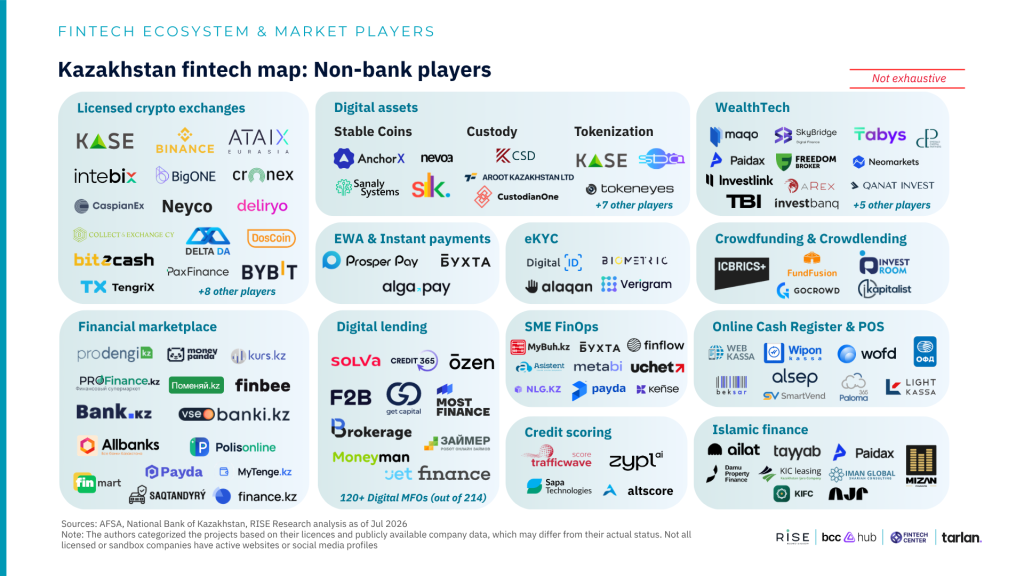
The five largest banks account for 69% of Kazakhstan’s total banking sector assets. Their apps bring together payments, lending, e-commerce, travel, transportation, government services, and other everyday services. Banks are also expanding their ecosystems in the small business segment. According to the study, they already offer solutions addressing 16 of the 19 key needs of small businesses — from company registration and account opening to payments, lending, employee payroll, and accounting services. As a result, the space for independent fintech companies and startups is narrowing.
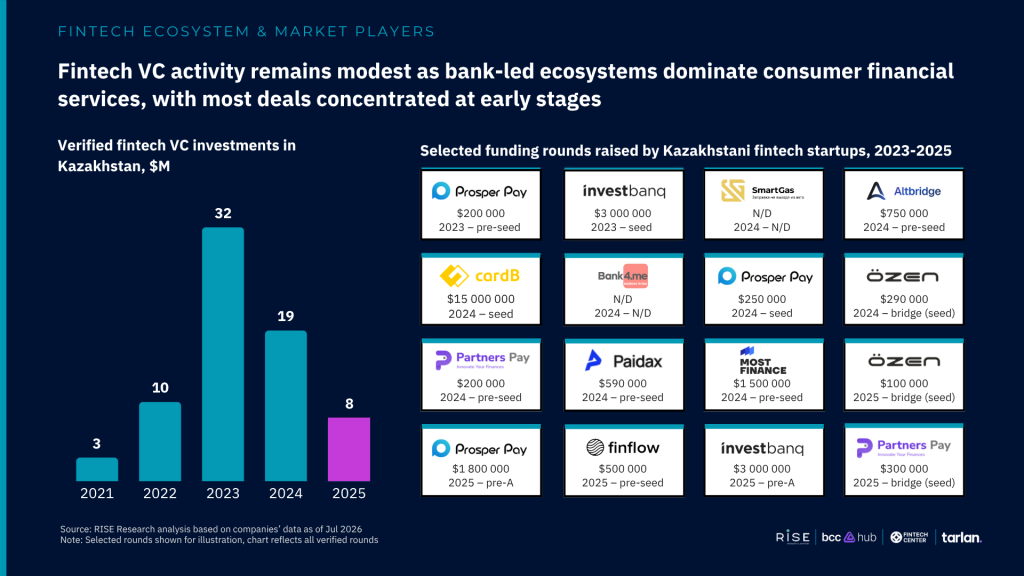
Between 2021 and 2025, Kazakhstan’s fintech startups attracted around $72 million in venture capital. Following a peak of $32 million in 2023, investment volumes declined to $19 million in 2024 and $8 million in 2025. At the same time, most deals are concentrated at the early stages. Investment activity is increasingly focused on B2B and infrastructure solutions.
2026 Has Been a Year of Regulatory and Infrastructure Reset for Kazakhstan’s Fintech Market
2026 has been one of the most active periods for financial regulation in Kazakhstan, with significant changes introduced across banking, digital, and tax regulation, new rules for the use of AI established, and a national regulatory framework for digital assets introduced. In parallel, important new elements of financial infrastructure have been launched — including interbank QR payments and phone-number transfers, the scaling of the digital tenge in the government spending system, the Anti-Fraud Center, and others.
The new Law on Banks and Banking Activities of the Republic of Kazakhstan introduces a two-tier licensing system, provides for the development of Open Banking and Banking-as-a-Service (BaaS), and expands opportunities for cooperation between banks and external technology companies. At the same time, requirements for risk management, cybersecurity, and data protection are being strengthened. As a result, financial infrastructure is becoming more open to small fintech companies while raising standards for all market participants.
Kazakhstan Is Building an Integrated Payments Infrastructure
Kazakhstan has already shifted to a predominantly cashless payments model: the share of cashless transactions reached 88% in 2026, compared with 67% in 2019. At the same time, the structure of payments is changing. The share of QR payments in the number of cashless transactions increased from 14% in 2023 to 28% in 2025. In January–May 2026, QR payment turnover reached approximately $17 billion, exceeding the turnover of POS terminal transactions for the second consecutive year.
On July 19, 2026, Kazakhstan’s unified interbank QR payment and phone-number transfer systems became operational across all retail banks in the country. At the same time, infrastructure is being developed to enable data exchange between banks and technology companies through open APIs. For banks, this is changing the nature of competition. As core payment infrastructure becomes increasingly standardized, proprietary payment solutions are no longer a standalone competitive advantage. Product quality, customer experience, data capabilities, and value-added services are becoming increasingly important.
“When core payment infrastructure becomes shared across the market, the ability to accept payments itself is no longer a competitive advantage,” says Andrey Sedenko, CEO of Tarlan Payments. “The winners will be those who can solve business needs quickly and transparently through a single interface, and support customers not only at the start but throughout their growth. For independent fintech companies, this is an opportunity to build specialized solutions on top of shared infrastructure and work with multiple banks at the same time.”
BaaS Is Becoming a Separate Market Segment
Banking-as-a-Service (BaaS) is gradually becoming a separate area of the market. While only a few banks offered such services several years ago, today at least four banks provide external companies with access to licensed banking infrastructure, processing, and other necessary services. This enables fintech companies and non-financial platforms to launch financial products using a partner bank’s infrastructure.
«Access to banking infrastructure is now available from several banks. The difference is not in the APIs, but in who takes on the operational side along with that access: onboarding, KYB, complaint handling, service levels, and the division of responsibility with the owner of the interface. Responsibility to the customer stays with the bank — which is why, for us, BaaS is an operating model rather than a product line», says Ruslan Yensebayev, CEO of BCC Hub.
Digital Assets Are Moving from Pilot Projects into the National Regulatory Framework
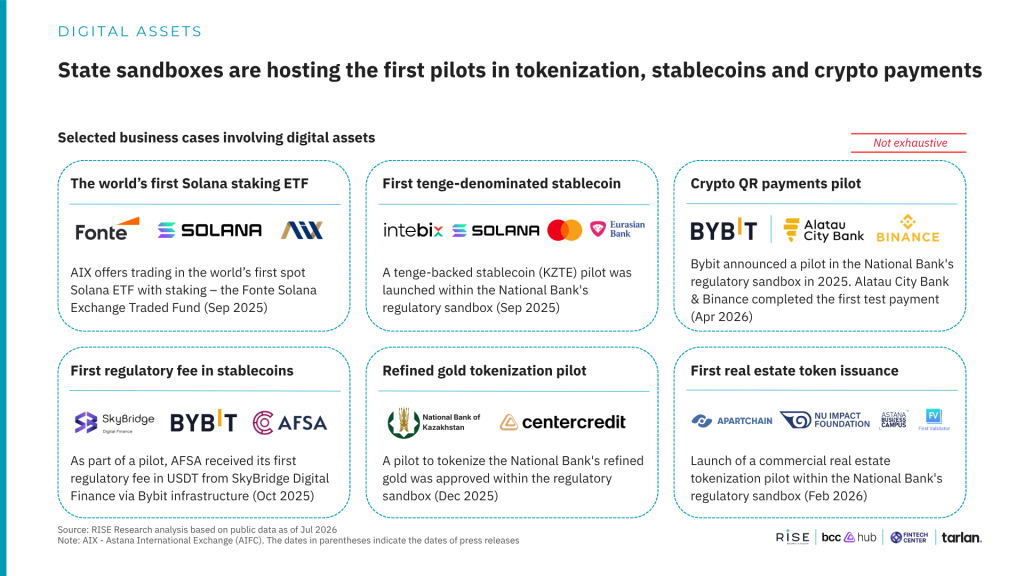
Since May 2026, Kazakhstan has operated under a national regulatory framework for digital assets, complementing the regime established by the Astana International Financial Centre (AIFC). In 2025, AIFC-licensed digital asset service providers processed $10.6 billion in transactions and served approximately 215,000 clients. At the same time, the market is gradually moving beyond crypto-asset trading. Kazakhstan has already launched or is testing a tenge-denominated stablecoin, the tokenization of gold and commercial real estate, and payments using digital assets. According to the study’s authors, the next stage of market development could be the scaling of real-world asset tokenization and its integration into traditional financial transactions.
“Competition has shifted to the infrastructure level: Open Banking, BaaS, and digital assets are a new frontier where leadership has yet to be established. For the first time, our report brings together data from the national framework and the AIFC into a single picture. This provides market participants and regulators with a common fact base for decision-making and developing a coordinated agenda,” says Dias Savetkhanov, CEO of Fintech Center.
A New Phase for the Market: Artificial Intelligence
Another important trend identified by the study is the deeper integration of AI into banking — from credit scoring and fraud prevention to software development and risk management.
“AI is already used by around 75% of banks in Kazakhstan — to assess customers’ creditworthiness, detect fraudulent transactions, and support marketing. The next stage is the combination of AI with BaaS, that is, external fintech services that companies can integrate into their products. This creates an opportunity for smaller technology startups to compete with larger players not through scale, but through their ability to solve specific customer problems more precisely,” says Ainur Zhanturina, CEO of RISE Research & Advisory.
The full version of the Fintech in Kazakhstan 2026 report is available on the RISE Research & Advisory website and on the websites of our partners.